Showing posts with label delhi. Show all posts

Tuesday, October 08, 2013

Progress. Justice. Peace

Last Sunday, I had the opportunity of attending a lecture delivered by Dr. A. K. Shiva Kumar, member of the National Advisory Council (NAC), a development economist,  a teacher at Harvard and whose PhD supervisor at Harvard was Dr. Amartya Sen. The lecture was this year's presentation at the Dr. Yuhanon Marthoma memorial lecture held annually by our church in Delhi.

The inaugural address was made by The Most Rev. Dr. Philipose Mar Chrysostom Mar Thoma Valiya Metropolitan (also known as the man with the golden tongue ;))  and presided by Rt. Rev. Dr. Abraham Mar Paulos, our bishop for Delhi. It was also the occasion where Advocate Lilly Thomas (who is unbelievably down to earth :)) was honored for her bold stance against tainted legislators which resulted in a landmark judgement by the honorable Supreme Court of India.

I will intersperse my notes of the main lecture by Dr. Shiva Kumar (may not be verbatim) with some interesting references from the web and some of my inferences.
Going beyond GDP as an indicator of human progress. 
GDP is today the de-facto performance indicator that is used to benchmark national progress. The wikipedia link and countless economics textbooks provide quite a few explanations on how exactly this number gets determined. However, the point being made is that the GDP perhaps misses out a lot more than it is believed and perceived to cover. It apparently measures "all except what is really worthwhile".
For example, capital cities usually have the maximum in terms of these economic indicators but fare the worst in some of the human indicators indicators. Beyond wealth, is the value of wealth. For example, access to education, freedom and other such indicators may be a better measure. This is what the governments must have provided to its citizens. GDP does tell something; for example, it took 40 years to double India's GDP but the next doubling happened in the last 10 years!
This is where I read about a very interesting alternate indicator. GNH or Gross National Happiness. GNH is apparently a very serious and a central indicator for our tiny neighbor Bhutan.

View Larger Map

Do read this article titled: Is Gross National Happiness more important than the GDP? by Josh Clark. It has many interesting links and insights into how GNH works. Here is an excerpt:

"...Rather than submit to the conspicuous consumption that characterizes much of the developed world, Bhutanese leaders chose to join the global economy on their own terms by measuring how the facets of its economy affect the positive outlook of its residents. Beginning in November 2008, all the economic factors used to measure gross domestic product are analyzed for their impact on Bhutan's residents' happiness. The factors of production are still there -- unemployment, agriculture, retail sales -- but GNH represents a paradigm shift in what's most valued by Bhutanese society compared to the rest of the world. In short, happiness matters, not money. The ultimate goal is economic support for the four pillars of Bhutanese society: economic self-reliance, preservation and promotion of Bhutanese culture, good governance and a pristine environment. [source: Mustafa]..."

Popular wisdom teaches us to measure happiness in monetary terms. While it is indeed true that the lack of access to money does restrict many and may force hardships on them, confusion arises when money becomes the sole object of pursuit and happiness takes a back-seat. Poverty is undoubtedly capable of becoming a viciously crippling cycle and that I believe is not being debated.

There are five types of growth failures. [I guess there was some reference to Human Development Reports here to which Dr. Shiva Kumar has been a contributor]. 
1. Jobless growth
92 million employment generated in the first 40 years. From 2005 to 2010, only 2 million net jobs added, despite the relatively high GDP growth exhibited in this interim. 
2. Ruthless growth
Gaps between bottom quintile and top increasing. Growing inequality. Apart from the obvious issues with this disparity, fundamentally, aggregate demand in the economy decreases. For example, consider the top 10 millionaires deciding to increase their consumption by 1% viz providing 10 million people with even a few thousand rupees of additional income. The scale and distribution of creation of economic opportunities is manifold in the second instance. Therefore, proper growth should result in proper distribution of wealth. 
3. Voiceless growth
When majority have little say in their own affairs. Prevention perhaps involves decentralized and distributed allocation and governance of public resources. Central schemes may miss out local needs and nuances. Also the pyramid will always be skewedly massive as it reaches the bottom rendering the top as perhaps ineffective 'representatives' of the collective.
4. Rootless growth
Honesty, integrity trustworthiness- when the intrinsic value of these words decreases, it results in rootless growth. Where people do not, from the inner-self, realize what is 'wrong' with corrupt or illegal or immoral practices. There is a limit to policing and enforcement. There needs to be a stress on the importance of an ingrained sense of fairness and justice. 
5. Future-less growth
The present generation using up resources as if there is no tomorrow. The way some of the mining deals have played out have been short-sighted to put it slightly. Results in squandering away the wealth of the nation.  
In short, growth as we know it is necessary but not sufficient. Quality is growth is what completes the growth story. Need to recognize that income is only a means, and has no intrinsic value.
After setting the foundation for an inclusive and true reflection of progress, the talk moved towards the other two key-words: Justice and Peace.
Views influenced by Amartya Sen who says that Justice must be seen as an 'enhancement of capabilities'. Progress is achieved when all the citizens have been enabled to appear in public without shame or fear. It is the 'widening of choices and the ability to enjoy them'. 'Dominating chance and circumstances'. Expansion of freedom to do what you want to do and be what you want to be. 'Assurance of human rights'. 'Removal of unfreedom'. 
The focus of Justice must be removal of perceptible injustices rather than trying to attain and define the Utopian just society.  
Do rights have meaning if they cannot be legally enforced? Human right surpasses legal rights, irrespective of laws. Its true that legal rights provide a better framework. Formally recognizing these rights builds up a social contract to enforce it. Absence of it removes a collective social conscience towards guaranteeing it. While arguing against some of the recent Right to education and Right to food bills, a common retort has been 'Where is the money?' The answer is that these "Just had to be done. Made into a political and social priority[-Sonia Gandhi?]". Also, "If you think education is expensive, try ignorance [Derek Bok]. There is a price [which may not always be apparent] of not putting some of these social contracts in place. The cost of inaction far outweighs the cost of implementing these. 
A sense equity and fairness are central to the idea of justice. There are a lot of invisible inequities. Eg: Sex, Caste, Age, Religion based, Location of birth. Also, there are conscious choices and unfair choices. These disadvantages should be focused on to remove injustice. 
On peace. Is there a linkage between poverty and violence? It is known that peace can co exist with poverty. So poverty alone does not explain violence. Lack of access to resources [poverty] however, has been one of the key reasons in uprisings and conflicts.
In the final part of the lecture, he briefly provided some thoughts on what the way ahead should be, to lead us towards a more inclusive, progressive and a just society:
1. Get much more agitated by injustice.
2. Be deliberately inclusive. When street vending bill was discussed, fees to be charged to then for use of public land was discussed. However, [strangely], no one talks about charging the more affluent for parking on public roads in some of the posh colonies in Delhi with the same conviction!
3. Have a greater accountability in public life.
4. Convert public grumbling into concerted public action.
5. Rethink how as a society we need to look at progress indicators. Ensure that we include things that really matter. Like happiness :)
Quite a lot of things to ponder upon as we get back to our rat-races blissfully blind to the slowly crumbling society around us. It would be great if at least some of us can think and contribute towards a more inclusive, just, peaceful and a happy world!

Monday, June 24, 2013

I wish 6. Parking the homeless

I wish all the covered parking spaces/ multi-level parking places (malls, office complexes, metro stations) would become paid sleeping areas for the homeless in our cities.

Most of these parking areas shut down for cars and vehicles around 1 PM (movie theaters) and around 10 PM otherwise. These places re-open for public by around 9 AM the next day. They say that on an average 10 people die on the streets of Delhi (dated) due to the extreme cold in winter and the harsh heat in summer while the rest of us enjoy a good night's sleep in the comfort of our homes, our cars sleep well in our garages and the glitzy shopping center parking areas are simply locked down.

I wish for a paid service where those who don't have a home can walk in to a parking lot, pay 50 rupees, get a parking ticket, rent a mattress, a blanket and park themselves at a spot where a car would have. Volunteers and social workers could co-ordinate basic amenities, cleanliness, law and order. Morning alarms  would wake them up and help them leave and clean up. This could be CSR for the property owners and a lifeline for thousands of homeless. The least our society can do is to treat them on par with our cars! No need to waste money trying to build the so called 'night shelters' 40 miles outside the city. Here's a bonus; should one of the rich-drunk-bmw-driving kids 'accidentally' miss the road and drive over a footpath, they would most likely end up killing their own motors and nothing else.

Further reading:

http://www.dailymail.co.uk/indiahome/indianews/article-2261809/Dying-cold-Lack-night-shelters-puts-Delhis-homeless-risk.html

The 'I wish' series will be short posts highlighting simple, interesting, innovative and useful twists to daily random routines and objects. 

Tuesday, September 11, 2012

Jugaad restaurant. Bicycle kitchen. Delhi

The cheapest kitchen on wheels. Has a small gas stove with a flat pan on top to make and serve naan, chappathis (kinda breads), and a large vessel with pre cooked chana masala (chickpeas). A full meal should cost around 20 rupees.


Monday, September 10, 2012

Jugaad lawnmower, Delhi

Rectangular frame, handles, rudimentary wheels, an AC motor attached to an MCB, wires and of course a whirring blade.

Let's call this Doer John, made in India ;)


Saturday, March 10, 2012

Trip to Sadda College NIT J aka REC Jalandhar

On a cold December morning, I received an email from one of the organizers of Techniti 2012 which contained an invitation to deliver a guest lecture at the event in the same engineering college that I am an alumnus of. Eko also sponsored the B-Plan competition at the event.

It had been 11 years since I had last walked out of the campus for good, so I thought it was a great opportunity to get back and check how it had fared after my departure ;-). Work had also been pretty hectic the past few weeks and thought this could be a good opportunity to take a break.

So, I confirmed my participation and told my folks that we would be going on a road-trip to sadda Punjab, sadda college. My folks did try to dissuade me from driving, but I persisted. Google maps told me that it was just around 400 Km from Delhi to Jalandhar- how bad could it be?


View Larger Map

Also, I remember when we were in the final semester; my good friend Rony and I had almost packed for a bike-trip (He had a Yamaha RX135? which all of us used to 'borrow' on campus) on this same route. We had helmets acquired and bags packed when at the last minute, his mom had managed to put in enough fear+tear pressure to scuttle our little adventure :(.

Trivia: The route we chose has a LOT of history riding on it. It is a segment of the Grand Trunk road that once stretched from Kabul to Calcutta and beyond. This was the road route which literally connected India to its history.

So, we started our journey on the 3rd March, exactly a week ago. It was a leisurely drive. Most of the road had been 4-laned, but there were patches where the work was still in progress. We stopped at a not-so-authentic '70 mile dhaba' and had aloo da paranthas with makkhan (chunk of butter) and daal makhani. Ah! For some strange reason it always taste better in a road-side dhaaba (road-side eatery for truckers and travelers).


It took us around 5 hours including a breakfast break to reach near Ludhiana. The road got more and more chaotic as we neared the center.

Trivia: Back in our college days, we knew Ludhiana as a place where a thousand little workshops ran a thousand lathes, where you could park a BMW and ask the legendary sardarji there to clone it and he could machine out one in a couple of days right from his lathe :-)!

The stretch from Ludhiana to Jalandhar was around 70 Km but took almost 2 hours!! Large stretches of the road were diverted due to the 4 lane construction activity. We reached Jalandhar sometime after 4 PM and debated whether we could go to Amritsar and Wagah border right away but decided to take rest instead. So we checked in at hotel Shekhon Grand (its a just-ok-for-rest kinda place) which had been booked by the organizers.

After we got fresh we went around for a drive through the city (town would be more appropriate). Visited Jyoti-chowk which was just about the only place which we used to visit from our college. Then I just drove for the heck of it, trying to see if I still remembered the route. Drove past the stadium, DAV college, Maqsuddan chowk, Suranussi and reached Bidhipur railway phaatak! (Encountered a flyover enroute and lots of working traffic lights- I am not very sure but I believe these things didn't exist back in our times)

Trivia: The new 4 lane thingy pulled a trick on me. I turned right into the main-road, expecting to pass by the college main gate where I could simply turn left and turn in. Would you believe that there is NO way you can turn into the campus from the main-road now except for taking a service lane right at Bidhipur junction OR go almost ALL the way down atleast 10 KM where this road begins!!! So if you ever decide to visit the college REMEMBER to take the service lane on the left; right at Bidhipur.

End result day 1: we went all the way to sadda college but ended up right where we had started back in sadda hotel room. Rest. Peace. End.

Day 2. Rise and shine. We started again at around 9. This time we clicked a few pics along the same route we had taken earlier.

Jyoti Chowk
Somewhere around Jalandhar

Sacred heart hospital
Random

The place right across our college
where all the rickshaws used to stop and
we used to walk across the railway track
Bidhipur faatak up ahead

At the faatak
Bidhipur Jn. See the dhaabas on the left?

Unfortunately, most of the dhaabas seem to have disappeared (or was I remembering it all wrong)! And I did NOT see any college kids loitering around here (kya zamaana aa gaya hai! -maybe its because it wasn't a normal working day).
Bidhipur, other side of the road

This used to be a dhaaba? Eek!

One that seemed to have survived

Bidhipur. more

The road that leads to the village, where we used to go for haircuts, STD calls, jalebis...

Leaving Bidhipur behind, we entered the service lane. Found that the little gate at the corner of the campus boundary wall is no longer there :(. The whole campus is now gated and barbed-wired I guess. So I arrive at the main gate and am greeted by security folks who jot down my name etc... lots of security folks all around. Thats a change.

Khul ja simsim.

Techniti Poster

What you'd see just after the gate roundabout


The security dude at the gate

The main gate

All four laned. See the concrete road dividers? Keeps gaadis from coming straight in

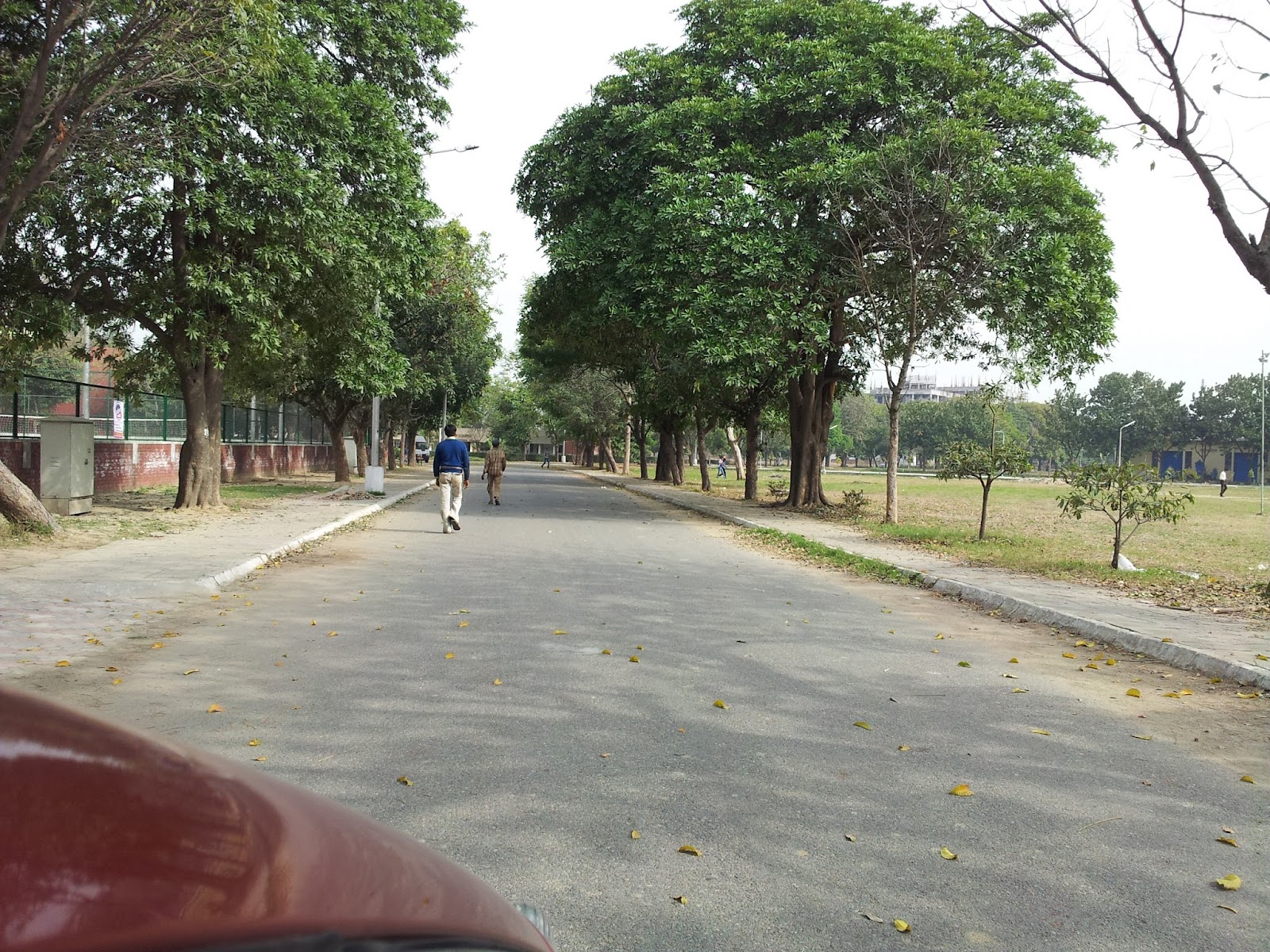
Now let me take you on a drive inside the campus. Much has changed. New buildings.

The new auditorium (the open air one is still there right opposite to this one)

Road to the guys hostels

New basketball court right before hostel no.1. There was a big gymnasium block as well right when you entered the main gate, on the left. Missed that one.

Hostel No. 1. Gated and all. With a security dedicated security dude cabin!

Hostel no. 1 again. First year was spent here. The gate was simpler back then. And you could jump (or be made to jump) out of ANY of the rooms on the ground floor. The security dudes were non-existent.

Hostel no. 3, the back side.

I guess the common entrance for Hostel no. 2 (where we had spent our second year) and the old PG hostel

Hostel no. 4. Notice the lawns and the closed gates? It used to be banjar land :) I think my room used to be on that face 1st/ 2nd floor.

The view after you exit hostel 4. The road less taken... ;)

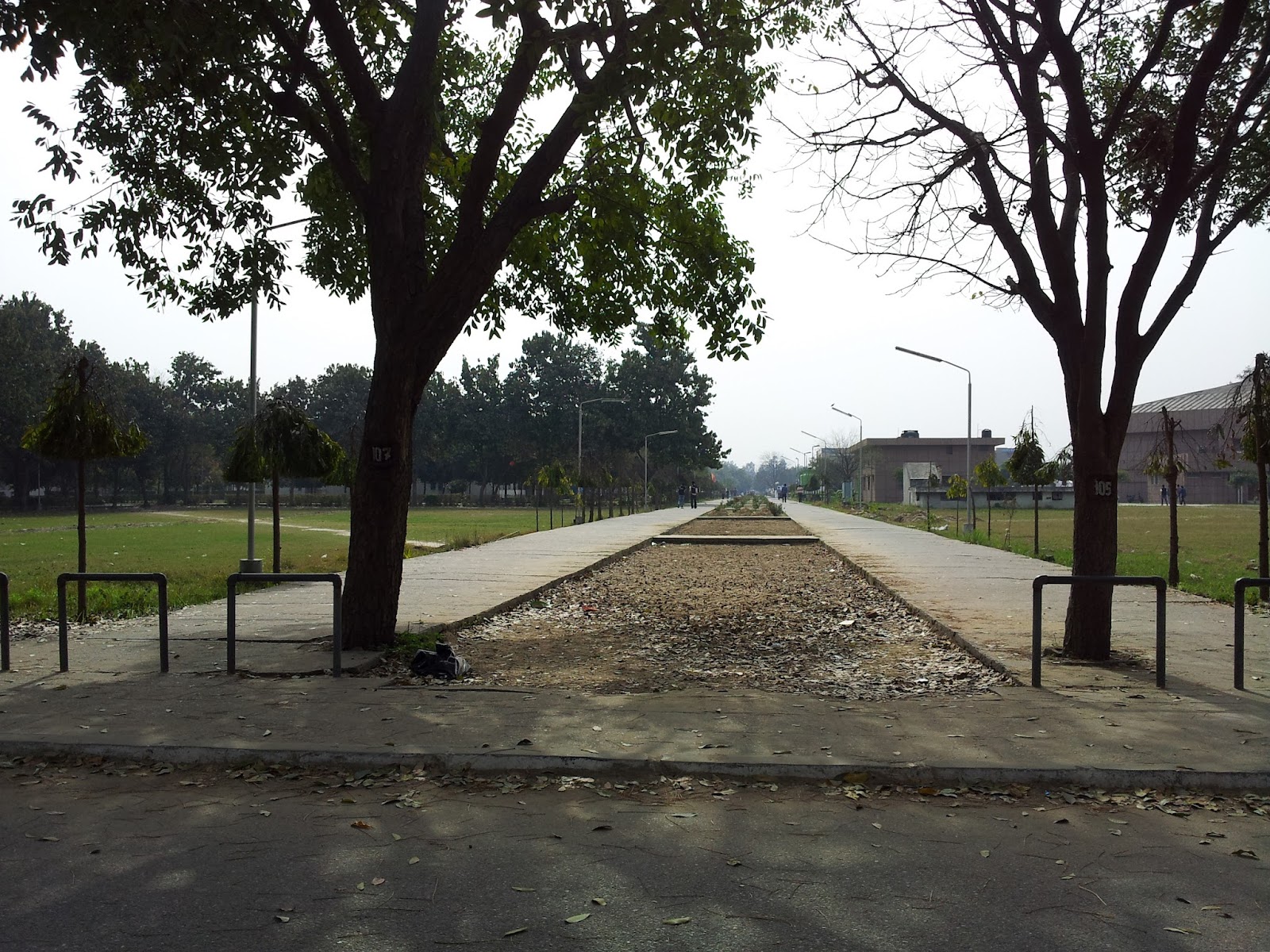
The walkway that connects the boys hostel side to the main academic blocks.

If you take left after the hostels (towards the old jhuggi place). Now there is a round-the-clock eatery here!

The mechanical workshops block. The file-file-file sessions, the lathes, et al.

This place turns into marsh land come monsoons, where we once played water football (or whatever that was called)

The new auditorium entrance. This is where I got to speak :)

You can see the open air audi straight ahead.

The admin block octagon. Also used to house the Electronics, Instrumentation and Computer Science depts. Computer science has got a shiny new block all for itself. The others are under construction. So the admin block will be left doing pretty much nothing pretty soon.

Roundabout 2 just after the gate, looking backwards.

The guest house

The walkway to the academic blocks from the guest-house side.

The shop area. (Where are all the people?)

Thankfully there is an ATM here now. Anyone remember standing at the tiny window of SBP there begging to get your own money out, updating passbook and stuff? That I hope is history.

I dont think the book shop has survived. I don't know about happy's juice shop either.

Atleast there was food!

sadda department

That apparently is the new super-duper set of boys hostel that is being built APART FROM the existing 6 boys hostel blocks! Looks great.

Inside the admin block; the bust of Dr. B. R. Ambedkar still stands.

Thats our family right inside the octagon. This is apparently where the admin folks now take 'rest' from their hectic work schedules.

This is not an airport lounge area. This is the waiting area for the new computer labs block! See the admin block through the glass front?

On the ground floor is video conf room plus an amphitheater. This is the only building which has an elevator inside ;)

Some gaadi prototypes

They did take part in some big competition. Don't remember which


The back-side of I guess the mechanical department. See some guy working on a vehicle prototype there? Thats apparently the workshop where the vehicle prototypes you saw earlier were put together.
Makes me very glad to see that :)

This used to be the jhuggi. Proves that the theory of evolution has some truth it it ;)

The jhuggi road. Back-side of a lecture theater.

The all new multi-storied lecture theatre blocks being built.


This place is the same. Actually its much worse than it used to be.

Then, I was taken in to the auditorium where the short-movies competition was on. It was wonderful to watch the creativity of the people who were putting together really good short stories. I got to watch two of them and was invited to give away the prize to the winning team which made a comical movie called 'har friend zaroori hota hai' which was on how some friends pranks played on the other (and their girlfriends) come back to bite them in the end :) Fun.
Movie screening

Movie screening 2
Then came my talks where the audi was pretty empty (compared to the movie screening). Obviously :). Anyways, I spoke about trying to exhort them find what they really loved to do and to pursue that with passion. Seemed to have gone well.

Then spent some time with Arun Khosla sir (who is now the ECE HOD!) who showed around the new building being constructed for ECE department.
New Electronics and Communications Engineering block under construction

Prof. Arun Khosla, Utkarsh Vijay one of the organizers of Techniti

We also spoke about the need to set up an incubation center and supporting innovative projects (will write more on that on a separate thread later). Had a quick lunch at sir's house. Met Mamta Khosla mam and their two kids. Had a good time and then started on the trip to Amristar and Wagah border.

The road from Jalandhar to Amritsar was makhaan. Smooth. Covered the 90 Km in less than an hour. Then at the junction took the road that turns right towards Atari and the Indo-Pak border. The closing the gates ceremony starts at 5 but we could reach only by around 5: 15.

Enroute we saw something that the region is famous for: Kite flying. Some pics:


The ceremony at the Wagah border is theatrical to say the least. Some things have changed since I'd been here last. For example, I don't recall the stadium like grand-stands on both the sides where people actually crowd in everyday to watch the spectacle. Parking has become good business with a few fields converted into dusty parking lots and rickshaw walaahs flying you to the venue.

The atmosphere is super-charged, loud and electric. Beyond the gate lies Pakistan. In-between lies no-man's land. On either side they cheer the performance of their soldiers.


Link: Random wagah border ceremony video

We then reached The Golden Temple at night. The services being rendered by the faithful, the utter devotion and dedication and the simple beauty of the temple at night was mesmerizing. I need to do some more history reading to really know more of its history. Thats on my to-do list now.


Finally, we started back to Jalandhar. Reached Jalandhar at midnight. Started back to Delhi early next morning. We were back in Delhi by evening.

Trivia: Almost after Sonipat there was a grand Pind Balluchi restaurant on the left. We thought we could dig in to some Tandoori chicken. Unfortunately this place was all VEGETARIAN! Grand, but vegetarian. So be warned :).


A trip down the memory lane. Back to sadda Delhi from sadda punjab, sadda Jalandhar and sadda college. If any of you had any common threads with the places I visited, hope this has brought some fond memories.

Here's to hoping and wishing that this institution (NIT Jalandhar) rises above the ordinary; as a place where real innovation, research and leaders are made!