Original image courtesy: https://pixabay.com/en/solder-station-arduino-kit-1548360/
I’ve been a tinkerer since as far back as I can remember. Here’s something I’ve realised: We are all born curious but the system lulls us into growing indifferent. We are all born tinkerers but the world is geared to make us feel safer as conformists. While conformist may not be the exact antonym for tinkerer, bear with me awhile. A tinkerer is someone who interferes or meddles with things. A conformists is one who never meddles.
....
[Click here to read the rest of the article on my Medium page]
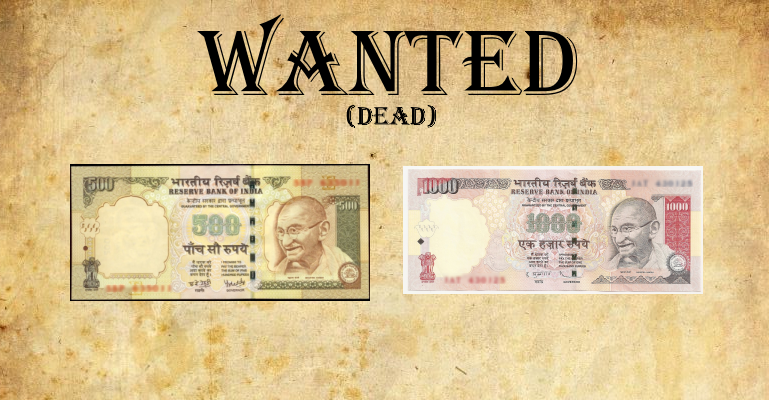
Around 8 PM. November 8th 2016. The Prime Minister, no less, declared that Rs. 500 and Rs. 1000 had been outlawed. Citizens who had given refuge to these bandits had no choice but to turn them in at a bank branch close to them. Chaos ensued. It was a state sponsored witch-hunt of sorts! An open and audacious attempt to assassinate Cash!
The crime? Cash, had this unique ability to remain under the radar. At the same time Cash was everywhere! It was certainly more popular than anything or anyone out there. As if Cash was leading a very popular Resistance. And Resistance has to be crushed. The move seemed to have broad support because of its prospect to weed out ‘black-money’ (sic).
This term itself is a great example of the bias we unwittingly promote. White is equated with good money and black is equated with ill-gotten gains. I wish there were a better term for it. I will refer to them as good-money and bad-money.
While Cash was one of the (many) instruments for those with bad-money, Cash actually represented good-money more! As a result of the witch-hunt, therefore, two sets of people suffered; Those who had hoarded bad-money through Cash and the voiceless majority, who depended completely on Cash. Cash was their good-money, and their only money.
If a certain output is directly proportional and dependent on a variable X. Guess what happens when X tends to zero?
India is known as a Cash based economy. ALL of the Banks, Wallets and Cards combined only covered less than 5 transactions out of every 100 while over 80 were through Cash! It was elementary therefore to deduce that an attack on Cash would push the Indian economy to a grinding halt. Many lives were and are being lost. What was initially billed as a surgical strike was evidently a carpet bombing. Cash was ubiquitous, especially the 500 and 1000 rupee notes. With carpet bombing, there is always collateral damage. In this case however, the collateral damage seems to have overshadowed the intended damage. The government had literally bombed its own economy! The official argument offered is that it this is supposed to be a short-term shock. There might be some solace in that argument, but for many who live from hand to mouth (In India, out of every hundred, over 20 live on less than two dollars a day) this was a rude and a fatal shock. For most of these people, a day with no wages translates to a day without food. Migrant workers who were trying to make a livelihood in urban centres, had been pushed to distress and many were reportedly heading back home.
I am a technologist. I have been at the forefront of an effort to induce digital and mobile payments in India. I have designed and implemented digital money platforms that have processed billions of dollars in digital transactions. However, at no point in time was I under a delusion that Cash could be defeated easily. Over the years, I have developed a healthy respect for Cash as a formidable opponent. In fact, we had even begun to treat it as a worthy ally! This may sound illogical at the outset, but please do bear with me. I have a healthy respect for PayTM, MobiKwik, its clones and the banks and all they have achieved in the de-monetization mayhem, and I wish them well in their endeavour. I hope they are not missing the trees for the woods. It is one thing to buy customers, to acquire them in their desperation and another to actually win them over.
Killing it softly
To those at the helm, the use of lethal and overwhelming force may sound like a logical method to wipe out the ‘Resistance’. Sure, when the opponent is a fringe group, force may overwhelm, but for a movement which is a mainstream way of life, like Cash is; diktats, executive orders and force might in fact achieve quite the opposite! IMHO, best way to subdue Cash is through empathy for the people who use it, a deep understanding of the various contexts and the use of smart design. Embrace Cash; then through a sustained campaign and specific design, ensure that people love Digital Money more than they love Cash. In fact unless Digital Money is designed to be actually loved more than Cash, forced usage only makes people hate it more.
The entire life-cycle of cash needs to be addressed. Start from the government, administration, banks, contractors, distributors, vendors, manufacturers, wholesalers, institutions and contractors. They need to be made digital first and then, enable them to trickle the benefits down to the individuals they employ and interact with.
The banks and the wallet players have a huge responsibility in being accessible and ensuring that the entire ecosystem is taken care of.
Beauty and the beast
Consider Cash for a moment. The beauty and the sheer simplicity of having coloured pieces of paper representing a certain ‘value’, based on the numbers written on them cannot be overstated. Paper Cash as a design solution for people to carry around ‘worth’, that could be combined by simply placing a particular set of such papers together, is wonderful! The ability to get change by exchanging a few leafs of paper is great. The ability to transfer it at proximity by simply handing it over is as intuitive a design as it gets! The most beautiful feature is that when two people are transacting using Cash, there is no third party involved. Just you, me and a sheaf of papers.
Why is this important? In a digital transaction involving banks and other stores of funds, instead of two individuals/ entities transacting, there is always atleast one more entity involved. Here, the individuals have entrusted their money to the ‘bank’ and merely ‘instruct’ their bank to pay someone on your behalf. Of course this is a non-trivial process that involves front-end devices, identity aliases, tokens, encryption (or lack of it), electricity, connectivity, multiple servers, leased lines, core-banking-systems, algorithms and what not! Each of these is beyond the direct control of the two parties primarily involved in the transaction. There are multiple points of failures and multiple factors of failure. Usually, these systems do work as designed, but the kind of up-times required for a nation to be exclusively dependent on it, is lacking.
It would be interesting to see offline digital wallet plays like PaySe playing out in this scenario. It is still a digital device, needs source of power and limited connectivity at the points of ‘loading/ unloading’; it does not require any internet connectivity while doing a transaction. Better, but still not quite as seamless as Cash.
Of course, there is the bitcoin/ crypto-currency narrative. While it does remove the issue of having to trust one entity (bank), it assumes the trust of a peer-network instead and still cannot function in the absence of connectivity. There are other practical issues as well, but that’s besides the point and is a topic for another discussion.
Guess what happens if you build a skyscraper without a solid foundation?
In a country like India where the basic infrastructure of electricity, computing and the internet have not been guaranteed (by the government or someone else), it is naive to assume either the availability or robustness or the proper functioning of these infrastructural elements. In the absence of these guarantees, is it wise to expect citizens to completely ditch Cash and adopt digital money? The government must first attempt making access to electricity, internet and computing a fundamental right and thus available to all its citizens BEFORE imposing instructions that incorrectly assume these elements are present.
Also consider the fact that these elements could be made unavailable either by design (read the many cases of internet being simply turned off by the authorities) or ‘force majeure’, acts of God. God forbid, citizens fall into either one of these events. The truth is, both of these are probable and plausible. Cash needs to be there atleast as plan B.
The progress being made by our minister for electricity, in terms of expanding access is commendable [Do visit this dashboard on Rural Electrification]; but the work is far from over and electricity is just one of the fundamental pieces of infrastructure that is missing. Priorities! Focus!
Time and motion
Sure, cash itself can be designed better! Take the new Australian bank notesfor example. For most routine transactions, Cash simply beats its alternatives in time and motion. [“Time and motion”! Abhishek, had literally drilled this phrase into my mind when my role involved designing the UI and UX for Eko]. While we were trying to shave micro-seconds and clicks off our cash-in/ cash-out transaction UX design, along came an executive order that added DAYS of standing in a line to an otherwise simple and benign transaction of cash withdrawal! To defeat Cash, you need make the UX of conversion between Cash and Digital Money absolutely seamless, non-intimidating and ubiquitous. You need to beat the existing “time and motion” thresholds not multiply them manifold!
In merchant payments, one often ignores the delay, cost and paperwork behind ‘merchant on-boarding’, PoS rentals, device cost, transaction cost, and support. What do you need to accept Cash? Nothing. Just an empty pocket. Even this UX needs to be beaten by Digital. One often hears of the cost incurred by the merchant to store, transport or pay someone else using this cash. Sure, we as solution designers have a problem with it, the government has a problem with it (no/ less tax), but the small merchant does not seem to have that big an issue with it. So, what do we do? We impose a solution. Could we do better? Yes, we could, by designing a better merchant proposition, a better UI for managing their customers, providing better analytics and value added solutions and tangible opportunities to grow their business.
Way of the future
Of course, there are instances where Digital Cash is way better! (Assuming that the basic infrastructure is present and available)
Where distances are involved. It is easier and cheaper to send money electronically across a thousand miles than to send it physically.
Access to credit is another example. Digital Money leaves a digital trail that reduces the cost of assessing the credit worthiness of an individual.
Storage in large quantities. It is indeed easier to store a million rupees as bits and bytes than in stacks of ten rupee notes.
Mass rapid transit. Impossible to imagine running the Delhi Metro without the smooth tap and go payment interface.
Digital Money is the way of the future, I have no doubt. But that future cannot just be hastened through executive orders or shortcuts. This future needs to be designed with empathy and customer-centricity. Of course, one could be reckless and get lucky, but should we count on it? Good design is rarely by accident. It needs time and resources. The path is long and arduous. Before tempting lady luck, the government would do well to ensure that robust basic infrastructure for enabling these are made available to atleast 99 out of every 100 citizens. Even 1 percent in country like India is over 12,000,000! Unlike most enterprises, the government and its actions need to be accountable for and accountable to every single citizen out there.
Re not De
Strictly speaking, as many have already pointed out, this entire exercise could be better referred to as #reMonetization rather than #deMonetization. While two denominations were withdrawn (500 and 1000), they were substituted by one new denomination (2000) and an existing one (500). From the current published trend, it seems like most of the old legit currency that was in circulation is expected to be deposited back at the bank. The currency presses are working on a full swing and a good portion of the demonetized value will be pushed back to the citizens, as new currency, but in an un-co-ordinated and unpredictable manner. The issue is that the gap between the De-monetization and the Re-monetization was significant and painful!
If Digital Money had to win, it should have been planned better. People now are only waiting to get back to (new) Cash! This explains the serpentine queues even 30 days post the D-Day. And once they get Cash, they will hold on to it. Simply because it is now a rare commodity. If Cash was easily accessible, people would not have minded this as much. IF!
When I first opened a bank account on my own (which was after graduation btw!), a major consideration was, to enroll in a bank that had the widest ATM network. Two reasons. One, indeed the acceptance network had barely started back then. Two, trust. The fact that I could, at will, get access to the physical and tangible manifestation of my savings induced trust. For the first time users of digital money, it is important to build up this trust and familiarity. When ATMs and access points are ubiquitous, people tend to withdraw less. Lesser the cash-in, cash-out and payment points, more the urge to hoard Cash. Because Cash is tangible and trust-able. Cash has this place of being the default money instrument.
Epilogue
Thus, right now it looks like only an attempt was made to kill Cash. A cold-hearted attempt and an audacious one no doubt. There is a lot of work to be done before someone even thinks of attempting this again! I hope people at the helm give UX, design and love a chance. If Cash needs to be killed, it must be killed softly.
The point of this post is not just to critique, but to lay out some pointers on the huge amount of work that is still required in the Digital Money space. Indeed, there is no going back and an upheaval of this magnitude is an opportunity. It is indeed awesome to see the government being involved in loudly supporting digital money. A lot more needs to be done and a lot differently. Caution needs to be exercised. There are real real people involved. Lives are at stake. This ain’t SimCity. This is my home. My people. My country.
[hindi: kyon? meaning: why?] India. Where Mahatma Gandhi, who exemplified non-violence, is venerated as the father of the nation. When a few people of this land; my land, use violence as the first resort to settle their ideological, political, religious or regional differences, it evokes anguish. Hence the question, why?
I wish we have traffic signals where cut-out cats pop-up on the road. No more plain red lights. Let me explain.
To anyone who has travelled on Indian roads, this should be pretty obvious; to others, it might sound fatally amusing. One thing that vehicle drivers in India seem inherently incapable of doing is stopping before the white lines drawn at traffic signals (that is if they decide to stop in the first place).
Thankfully, there is ONE thing that can stop almost all of them: cats. A cat crossing ones path is considered inauspicious (to put it mildly) and Indians would do anything to avoid being crossed thus! A larger animal's cut-out; a cow's for instance, would have been eminently more visible, but that would not have served the purpose since the holy cows are considered very much a part of the road ecosystem and people are adept at swerving right past them.
Note: No animals were harmed or intended to be harmed for this post. The cut-outs could very well be made of indestructible silicon, latex and fibreglass sheets.
The 'I wish' series will be short posts highlighting simple, interesting, innovative and useful twists to daily random routines and objects.
"Mirror, mirror, on the wall, who's the most corrupt of them all?"
There is this story from the Bible [John 8: 1-11], of a 'condemned' woman, about to be stoned as the 'rules' then required, being brought infront of Jesus. His simple response was to ask anyone from the crowd who had never sinned, to throw the first stone. Each one of the accusers slithered away.
I tried to imagine. If this incident had happened in the world we are living in today, not only would she have been stoned by the very people who had 'caught' her, each one of them; her captors would most likely also have been her past clients. One could almost mistake hypocrisy for a virtue these days!
A case in point: It has apparently become fashionable for Indians to accuse India of being very corrupt. The problem is that most of us seem to look elsewhere for an answer. Maybe its an overdose of Harry Potter movies on our cable TVs? We seem to be searching for a magic wand. And perhaps a magic mantra to go along- 'arrestus corruptus'? Perhaps its an overdose of Hollywood. We seem to be waiting for super-heroes to set this right. Well, super-heroes are fictional. Maybe a few larger than life political netas could do instead? Yeah! Hmm..maybe! Bingo! We need 'em laws to set us right! Draft 'em bills! A thousand pages at font ten, no less! Smirk! How dare I corrupt now?
Considering the length and breadth of some of the scandals that have been unearthed in the recent past, one could be forgiven for expecting a miracle. Unfortunately, that miracle needs to start from within: within each of us. That is exactly where it gets tough. Really tough. We're so mired in the muck that its almost become second nature. Pigs don't think they get dirty when they frolic in the sewer, they kinda enjoy it! Asking pigs to suddenly behave like royal felines is TOUGH. Tough is an understatement. It needs a miracle!
And miracles do happen. I believe in miracles. This one starts with a simple mirror. And me. And you. And a little bit of introspection.
Just ask the man or the woman in the mirror. He or she has all the answers.
"Or how can you say to your brother, 'Let me take the speck out of your eye,' and behold, the log is in your own eye? You hypocrite, first take the log out of your own eye, and then you will see clearly to take the speck out of your brother's eye." [Mathew 7: 1-5]
The world wide web represents democratization of news and views. The sheer freedom it provides as an independent platform above and beyond geographic boundaries sometimes makes its users forget that they still need to operate within the limits imposed by the laws of the land they are otherwise governed by.
I came across this interesting site http://www.facebooklaw.in published by some Asian School of Cyber Laws. It is an interesting portal which lists out a few dos and donts based on Indian laws. The gist is as follows: "Before posting on Facebook, ask yourself one question - If this comment were about my family, or me, would I be offended? If your answer is yes, DO NOT post." Read this short document they have put up to get a broad sense of what this is all about: https://www.dropbox.com/s/hehaj7lrfkx8s8e/facebook_law_in_india.pdf
There are of course exemptions where the defendant could prove that his words were factual or for greater public good. But it also points out that if the words incite undue tensions in a particular group of people, it could be considered defamatory. While on one hand this law may be used by the powerful to quiet voices of legitimate criticism, on the other hand it empowers people to protect their dignity if they feel offended.
I learnt that it is good to be aware of the following sections under the Indian Penal Code (I am no lawyer and do not understand much beyond the plain English extracts here. Also read the Cyber Crimes link at the very last):
Section 469. Forgery for purpose of harming reputation
(Some people may forge an identity to post something defamatory. This apparently is in itself wrong.)
Whoever commits forgery, 1[intending that the document or Electronic Record forged] shall harm the reputation of any party, or knowing that it is likely to used for that purpose, shall be punished with imprisonment of either description for a term which may extend to three years, and shall also be liable to fine....
Section 499. Defamation
(Can't offend. There are exceptions of course. Read the indiankanoon link above)
Whoever, by words either spoken or intended to be read, or by signs or by visible representations, makes or publishes any imputation concerning any person intending to harm, or knowing or having reason to believe that such imputation will harm, the reputation of such person, is said, except in the cases hereinafter expected, to defame that person....
Section 504. Intentional insult with intent to provoke breach of the peace
(Can't intentionally provoke)
Whoever intentionally insults, and thereby gives provocation to any person, intending or knowing it to be likely that such provocation will cause him to break the public peace, or to commit any other offence, shall be punished with imprisonment of either description for a term which may extend to two years, or with fine, or with both.
Section 505. Statements conducing to public mischief
(No rumor mongering)
1[505. Statements conducing to public mischief.—2[(1)] Whoever makes, publishes or circulates any statement, rumour or report,—
(a) with intent to cause, or which is likely to cause, any officer, soldier, 3[sailor or airman] in the Army, 4[Navy or Air Force] 5[of India] to mutiny or otherwise disregard or fail in his duty as such; or
(b) with intent to cause, or which is likely to cause, fear or alarm to the public, or to any section of the public whereby any person may be induced to commit an offence against the State or against the public tranquility; or
(c) with intent to incite, or which is likely to incite, any class or community of persons to commit any offence against any other class or community,
shall be punished with imprisonment which may extend to 6[three years], or with fine, or with both.
Section 507. Criminal intimidation by an anonymous communication
(No anonymous threatening)
Whoever commits the offence of criminal intimidation by an anonymous communication, or having taken precaution to conceal the name or abode of the person from whom the threat comes, shall be punished with imprisonment of either description for a term which may extend to two years, in addition to the punishment provided for the offence by the last preceding section.
We should look at our inherent strengths to solve some of our pressing needs. As a country, there are a few things pretty peculiar about India. Take for instance, the sheer size of some of its problems. Some of our 'problems' are as large as a few other countries' entire populations put together. Herein lies the opportunity as well. We are also, a massive sea of humanity yearning to serve its unmet needs and earn our rightful place under the sun. Technology has a huge role to play as well; not at loggerheads but complementary.
October last year, Abhishek (Eko) and Ignacio (ex BMGF) published a post on IFMR blog titled 'Extending the third-party aggregator model from ATMs to Business Correspondents'. This was a revolutionary thought and got picked up by the Nachiket Mor committee on Comprehensive Financial Services for Small Business and Low Income Households. The report was released by RBI recently and has generated quite a few discussions for its take on how retail banking needs to evolve in India.
Just to set the context, Business Correspondents (BCs) are firms or individuals who provide banking services to customers on behalf of a bank. The RBI established the BC model sometime in 2006 to solve the financial inclusion needs of this country. The BC provides the last mile access, reaching where a bank could physically and economically not reach through traditional means. BCs are currently tightly coupled to a particular bank. The BC would feature the brand of its bank, offer products of its bank and liaise with the branches of its bank only. However, interoperability in transactions is conceptually promoted and to an extent implemented. The BC is therefore a human ATM (and more, since the BC can do much more than an ATM can) and the community banker/ an agent of the bank.
Most implementations of the BC network by the banks have only attempted to comply to RBI/ finance ministry mandates for financial inclusion and have been restricted to 'Open X accounts in Y villages' or 'Disburse X rupees of government benefits to Y people'. Most of these initiatives have therefore been seen as cost-centres and as regulatory obligations by the banks and rarely have these been viewed as profit-centres or even as viable business units.
After spending many years in mere obligatory compliances and having spent significant amounts of money to fuel these endeavours, a few banks like the State Bank of India and the ICICI Bank have realized the need to turn this model around. Someone in these banks has rightly put his/ her foot down and said that the whole movement needs to be viable, sustainable and scalable to have any real and meaningful impact.
A few BCs themselves have seen that they could not sustain with a fundamentally non-viable business model. Eko, for instance, has been a BC which has used technology to ensure that its costs were razor thin, invested in ensuring a great user experience and has innovated on the products along with the banks. In short, it is in the best interests of a BC also to ensure that more and more customers, transactions and products flow through their channel and that most of these activities generate enough revenues to sustain them and their partners in the value-chain.
White label ATMs are a relatively new phenomenon for India where a third-party owns and operates a network of ATMs under its own brand and not necessarily for/ by a particular bank. The Tatas and The Muthoot Group have already started setting up their WLATMs in India.
Lets assume that a typical ATM machine costs Rs. 10 lac to deploy, maybe cost a Rs. 1 lac to maintain (rental, electricity) annually. Also, the average life of an ATM would be 5 years. So 5 years on, we must budget for some amount to replace atleast some parts of this machine, lets say this is just Rs. 5 lac. Assume that the ATM earns Rs. 8 per transaction. Ignoring the cash management costs, and security costs (which would be significant) and any other overheads; to break-even, every ATM needs to process approximately 140 transactions per day, every day for the next 5 years.
Also, of course, to set up a network of say a 10,000 ATMs, the capital expenditure is going to be significant (Rs. 10,00,000 x 10,000) and that capital comes at some cost.
Again, the following articles provide some context: A recent article in Times of India pegs a deficit of 19,000 odd ATMs for the public sector banks India compared to the targets set. Also, interesting is this article which quotes officials from SBI, which operates the largest ATM network in India, saying that its ATM operations were loss making.
Now, technology moves ahead way faster than banking can. Mobile banking/ commerce is slowly but steadily getting popular. The RBI has also published that it envisions a less-cash (though not a cashless) society in the near future. For all we know, physical cash might actually become much less relevant in the next 5 to 10 years. Perhaps mobiles will take over where cards have not? While this seems implausible, take a look around; if 10 years ago, someone had told me that almost every economically active individual in India would have a mobile phone, I would have laughed. Video conferencing/ tele-presence used to be stuff from science fiction! My mobile phone has more processing power today than the all the computers in my school lab put together. I am not implying that ATMs would become irrelevant anytime soon- indeed these machines would themselves evolve in ways we may not anticipate today, but they are definitely under time pressure.
With access to one tenth the capital required for ATMs, we could set up a human ATM network that is a hundred times larger. Consider a human ATM network that uses mobile phones/ mPoS as access devices. Add to it the fact that it would not need to overheads that a normal ATM would need, including power, rental etc. Also significant is the fact that much leaner and efficient cash management systems could get deployed here. The result would be a low-Opex and very low-Capex network of banking agents who would not only do cash-in/ cash-out but also educate, solicit and facilitate enrolment to a range of financial products. Also, these costs are nothing but investments in people; in agents who are entrepreneurs. Any improvement in their livelihood would only have a positive rub-off in the community that they serve and the nation at large.
The white label BC model, would achieve a sort of decoupling for the banks where banks would be freed up from having a operationally heavy involvement in these activities. Having endorsements from multiple banks or the central bank itself would create an environment of trust as a legitimate banking channel even for existing customers across different banks and thus more footfalls. This could result in better returns for the agents involved and could lead to a viable and sustainable financial ecosystem designed for outreach and customer convenience.
This model is not without its short-comings though. Managing a huge network of agents is no easy task. Selecting and appointing them is no cakewalk either. Also, people, as they say, are more vulnerable to break-downs than machines are. Each of these risks can arguably be mitigated through appropriate processes, technologies and audit mechanisms.
Prevalent perception is that while technology makes things more efficient, it also causes banking to lose the human touch. Perhaps it is prudent to seek a middle ground here, especially as this also involves introducing hitherto unbanked people to a formal financial system. A little hand-holding and human touch should be welcome, right? Eager to see how this concept plays out.
Last Sunday, I had the opportunity of attending a lecture delivered by Dr. A. K. Shiva Kumar, member of the National Advisory Council (NAC), a development economist, a teacher at Harvard and whose PhD supervisor at Harvard was Dr. Amartya Sen. The lecture was this year's presentation at the Dr. Yuhanon Marthoma memorial lecture held annually by our church in Delhi.
The inaugural address was made by The Most Rev. Dr. Philipose Mar Chrysostom Mar Thoma Valiya Metropolitan (also known as the man with the golden tongue ;)) and presided by Rt. Rev. Dr. Abraham Mar Paulos, our bishop for Delhi. It was also the occasion where Advocate Lilly Thomas (who is unbelievably down to earth :)) was honored for her bold stance against tainted legislators which resulted in a landmark judgement by the honorable Supreme Court of India.
I will intersperse my notes of the main lecture by Dr. Shiva Kumar (may not be verbatim) with some interesting references from the web and some of my inferences.
Going beyond GDP as an indicator of human progress.
GDP is today the de-facto performance indicator that is used to benchmark national progress. The wikipedia link and countless economics textbooks provide quite a few explanations on how exactly this number gets determined. However, the point being made is that the GDP perhaps misses out a lot more than it is believed and perceived to cover. It apparently measures "all except what is really worthwhile".
For example, capital cities usually have the maximum in terms of these economic indicators but fare the worst in some of the human indicators indicators. Beyond wealth, is the value of wealth. For example, access to education, freedom and other such indicators may be a better measure. This is what the governments must have provided to its citizens. GDP does tell something; for example, it took 40 years to double India's GDP but the next doubling happened in the last 10 years!
This is where I read about a very interesting alternate indicator. GNH or Gross National Happiness. GNH is apparently a very serious and a central indicator for our tiny neighbor Bhutan.
"...Rather than submit to the conspicuous consumption that characterizes much of the developed world, Bhutanese leaders chose to join the global economy on their own terms by measuring how the facets of its economy affect the positive outlook of its residents. Beginning in November 2008, all the economic factors used to measure gross domestic product are analyzed for their impact on Bhutan's residents' happiness. The factors of production are still there -- unemployment, agriculture, retail sales -- but GNH represents a paradigm shift in what's most valued by Bhutanese society compared to the rest of the world. In short, happiness matters, not money. The ultimate goal is economic support for the four pillars of Bhutanese society: economic self-reliance, preservation and promotion of Bhutanese culture, good governance and a pristine environment. [source: Mustafa]..."
Popular wisdom teaches us to measure happiness in monetary terms. While it is indeed true that the lack of access to money does restrict many and may force hardships on them, confusion arises when money becomes the sole object of pursuit and happiness takes a back-seat. Poverty is undoubtedly capable of becoming a viciously crippling cycle and that I believe is not being debated.
There are five types of growth failures. [I guess there was some reference to Human Development Reports here to which Dr. Shiva Kumar has been a contributor].
1. Jobless growth 92 million employment generated in the first 40 years. From 2005 to 2010, only 2 million net jobs added, despite the relatively high GDP growth exhibited in this interim.
2. Ruthless growth Gaps between bottom quintile and top increasing. Growing inequality. Apart from the obvious issues with this disparity, fundamentally, aggregate demand in the economy decreases. For example, consider the top 10 millionaires deciding to increase their consumption by 1% viz providing 10 million people with even a few thousand rupees of additional income. The scale and distribution of creation of economic opportunities is manifold in the second instance. Therefore, proper growth should result in proper distribution of wealth.
3. Voiceless growth When majority have little say in their own affairs. Prevention perhaps involves decentralized and distributed allocation and governance of public resources. Central schemes may miss out local needs and nuances. Also the pyramid will always be skewedly massive as it reaches the bottom rendering the top as perhaps ineffective 'representatives' of the collective.
4. Rootless growth Honesty, integrity trustworthiness- when the intrinsic value of these words decreases, it results in rootless growth. Where people do not, from the inner-self, realize what is 'wrong' with corrupt or illegal or immoral practices. There is a limit to policing and enforcement. There needs to be a stress on the importance of an ingrained sense of fairness and justice.
5. Future-less growth The present generation using up resources as if there is no tomorrow. The way some of the mining deals have played out have been short-sighted to put it slightly. Results in squandering away the wealth of the nation.
In short, growth as we know it is necessary but not sufficient. Quality is growth is what completes the growth story. Need to recognize that income is only a means, and has no intrinsic value.
After setting the foundation for an inclusive and true reflection of progress, the talk moved towards the other two key-words: Justice and Peace.
Views influenced by Amartya Sen who says that Justice must be seen as an 'enhancement of capabilities'. Progress is achieved when all the citizens have been enabled to appear in public without shame or fear. It is the 'widening of choices and the ability to enjoy them'. 'Dominating chance and circumstances'. Expansion of freedom to do what you want to do and be what you want to be. 'Assurance of human rights'. 'Removal of unfreedom'.
The focus of Justice must be removal of perceptible injustices rather than trying to attain and define the Utopian just society.
Do rights have meaning if they cannot be legally enforced? Human right surpasses legal rights, irrespective of laws. Its true that legal rights provide a better framework. Formally recognizing these rights builds up a social contract to enforce it. Absence of it removes a collective social conscience towards guaranteeing it. While arguing against some of the recent Right to education and Right to food bills, a common retort has been 'Where is the money?' The answer is that these "Just had to be done. Made into a political and social priority[-Sonia Gandhi?]". Also, "If you think education is expensive, try ignorance [Derek Bok]. There is a price [which may not always be apparent] of not putting some of these social contracts in place. The cost of inaction far outweighs the cost of implementing these.
A sense equity and fairness are central to the idea of justice. There are a lot of invisible inequities. Eg: Sex, Caste, Age, Religion based, Location of birth. Also, there are conscious choices and unfair choices. These disadvantages should be focused on to remove injustice.
On peace. Is there a linkage between poverty and violence? It is known that peace can co exist with poverty. So poverty alone does not explain violence. Lack of access to resources [poverty] however, has been one of the key reasons in uprisings and conflicts.
In the final part of the lecture, he briefly provided some thoughts on what the way ahead should be, to lead us towards a more inclusive, progressive and a just society:
1. Get much more agitated by injustice. 2. Be deliberately inclusive. When street vending bill was discussed, fees to be charged to then for use of public land was discussed. However, [strangely], no one talks about charging the more affluent for parking on public roads in some of the posh colonies in Delhi with the same conviction! 3. Have a greater accountability in public life. 4. Convert public grumbling into concerted public action. 5. Rethink how as a society we need to look at progress indicators. Ensure that we include things that really matter. Like happiness :)
Quite a lot of things to ponder upon as we get back to our rat-races blissfully blind to the slowly crumbling society around us. It would be great if at least some of us can think and contribute towards a more inclusive, just, peaceful and a happy world!
I wish all the covered parking spaces/ multi-level parking places (malls, office complexes, metro stations) would become paid sleeping areas for the homeless in our cities.
Most of these parking areas shut down for cars and vehicles around 1 PM (movie theaters) and around 10 PM otherwise. These places re-open for public by around 9 AM the next day. They say that on an average 10 people die on the streets of Delhi (dated) due to the extreme cold in winter and the harsh heat in summer while the rest of us enjoy a good night's sleep in the comfort of our homes, our cars sleep well in our garages and the glitzy shopping center parking areas are simply locked down.
I wish for a paid service where those who don't have a home can walk in to a parking lot, pay 50 rupees, get a parking ticket, rent a mattress, a blanket and park themselves at a spot where a car would have. Volunteers and social workers could co-ordinate basic amenities, cleanliness, law and order. Morning alarms would wake them up and help them leave and clean up. This could be CSR for the property owners and a lifeline for thousands of homeless. The least our society can do is to treat them on par with our cars! No need to waste money trying to build the so called 'night shelters' 40 miles outside the city. Here's a bonus; should one of the rich-drunk-bmw-driving kids 'accidentally' miss the road and drive over a footpath, they would most likely end up killing their own motors and nothing else.
It is said that India will surpass China in terms of the number of 'working-age' population sometime in the next decade. That would be a whopping billion (mostly the next generation) from India and another billion from China alone!
While this phenomenon is being hailed as the 'demographic dividend' by many, a few foresee this as 'demographic disaster'. They say it is a potent mega-ton-arab-rising building up. The sad part is that nothing seems to be evident at this point which tilts the outlook in the favor of a dividend rather than a disaster. Neither are strong actions being taken to strengthen and retain the fundamentally agrarian nature of this populace nor are adequate steps being taken to create industries (what will actually kick-start this demand-supply cycle? factories? who will fund these industries? government?) that could provide a suitable employment opportunity. One facet of this problem is that most (70 to 85%) of the 'jobs' that seem to be getting created are in the so called 'informal sector' (read: plain wage earners, no papers, no security, short-term)
Lets zoom in a bit more here. Two 'jobs' that seem to have a huge demand in the rapidly 'urbanizing' India are: drivers/ chauffeurs and security guards. Informal, mostly. Most of their time on these jobs are spent waiting. A driver spends a couple of hours every day actually driving and the guard spends the entire day sitting on a chair 'guarding', which is again waiting (and watching their employers who seem to be from a different planet altogether). Hundreds of thousands of youngsters in India today thus spend hundreds of thousands of hours just waiting. An idle mind, they say, is the devil's workshop. And some of these people are even graduates! I can only imagine that a graduate devil's workshop will be scarier!
Well, some employment is anyway better than no employment. Right? Agree :-). My only wish is that someone comes up with a better way to utilize their 'bench' times. Here are the key ingredients: lots and lots of people. Almost all of them have mobile phones. And a lot of idle time. Imagine if all the complex human jobs could be divided into snack sized sachet jobs? Now put all of these together to create a solution.
Another way to look at this is to take an inspiration from the way a computer works. There are many layers of abstraction here. The web-browser that you are reading this very blog on is at the top-most layer in the stack. As you go a level deeper, you will hit a standard instruction set that tells the microprocessor to store something, move it, add it etc. Dig down and you will find that everything boils down to an immense array of transistors switching as logic gates. Your computer is just an orchestrated machine with millions of identical and individually simple (and microscopic) electronic toggle switches that can together be instructed to perform seemingly complex routines.
I am not sure what the solution should exactly be :(. I don't even know if it is even possible to actually develop one! However, I do know that it could make a (huge) difference for both the employed and the unemployed and their nations. To rephrase the challenge:
Create snack-jobs; reduce the unit definition of a job from a month/ week/ day to maybe a couple of minutes. Create a platform to automatically break down seemingly complex problems/ jobs/ tasks (which are best done by a human) into a very large set of smaller but simpler tasks (that do not require any specialized skill or education to execute), orchestrate a massive distribution of these jobs using mobile phones and an aggregation of the results using technology in real-time or near real time, featuring necessary error corrections through crowd-sourcing. Present the output to the systems that require it. Provision some form of incentive to each of the human contributors. Also, possibly allow for people to move up the skill chain to handle more and more complex abstraction layers.
Perhaps it would pan out as puzzle games that are simple at first but get more and more difficult on level ups? A micro way to perhaps address a macro problem? Any takers?
When I look back at the 'education' I've got, I realize how worthless most of it (not all) has been. Arguably, the system is geared towards giving a pretty broad foundation on which individuals are supposed to build their sophisticated lives on. Education could thus be summarized as the spray-and-pray approach at the bottom and you-better-find-your-groove expectation as you get older.
If the aim of early schooling is to provide an awareness of the limitless options available and to enable a student to choose one when he is ready to - that is a worthy cause! But what if this ends up creating a generation of 'exam writers' ? Unhappy and corrupt citizens? People who can crack question papers problems but not real-life problems? I would not be very wrong if I say that this is what we have ended up with in India. There is a looming talent deficit that this emerging economy has to deal with. More worryingly, a good percentage of 'graduates' that this country churns out, are marked as unemployable! Recently, my colleague Mansi lent me her book 'Surely You're Joking, Mr. Feynman' to read. The book is a collection of anecdotes of the Nobel Prize winning, Richard Feynman. First published in 1985! What is interesting in that book is his critique on the education system that existed in Brazil. Excerpt (click this link on Rob Shearer's site to read more):
The lecture hall was full. I started out by defining science as an understanding of the behavior of nature. Then I asked, “What is a good reason for teaching science? Of course, no country can consider itself civilized unless… yak, yak, yak.” They were all sitting there nodding, because I know that’s the way they think. Then I say, “That, of course, is absurd, because why should we feel we have to keep up with another country? We have to do it for a good reason, a sensible reason; not just because other countries do.” Then I talked about the utility of science, and its contribution to the improvement of the human condition, and all that – I really teased them a little bit. Then I say, “The main purpose of my talk is to demonstrate to you that no science is being taught in Brazil!” I can see them stir, thinking, “What? No science? This is absolutely crazy! We have all these classes.” So I tell them that one of the first things to strike me when I came to Brazil was to see elementary school kids in bookstores, buying physics books. There are so many kids learning physics in Brazil, beginning much earlier than kids do in the United States, that it’s amazing you don’t find many physicists in Brazil – why is that? So many kids are working so hard, and nothing comes of it.If Feynman landed in India, I am sure he would have penned a similar chapter. Interestingly, Indians who continue their studies abroad seem to do well for themselves. The institutions abroad seem to be able to instill something in them that makes them thrive.
On the eve of India's Independence Day, let me attempt at putting together what I would really have wanted my school(s) to have taught me.
'The School of Thought' would only define the minimum education required, the maximum would be up to the students. The idea is NOT to enable them to recite the definition of addition, but the ability to actually add any two numbers up.
The following would be the ONLY mandatory subjects:
1. Language. Two languages, English and the mother-tongue. Alphabet. Words. Grammar. Phrases. Sentences. Prose. Poetry. Songs. Stories. The pupil must be able to tell stories and read and understand stories.
2. Arithmetic. Numbers. Counting. Concepts behind Addition, Subtraction, Multiplication and Division. Tables. Mental Arithmetic. Estimation. The pupil must be able to handle all the calculations required in daily life.
3. People. Self. Others. Family. Friends. Acquaintances. Colleagues. Life Partners. The Opposite Sex. Listening. Thinking. Meditating. Caring. Negotiating. Integrity. Context. Diversity. Perception. The pupil must be able to understanding what he/ she needs and expressing it. Grasping different contexts, people, body language. Speaking tactfully. Understanding what others want.
4. Money. Saving. Borrowing. Lending. Taxes. Giving. Make a living. Enjoying work- doing what you love doing. Starting a small enterprise. Planning for a big one. Value of having/ not having. How does money work? The pupil must understand the need and value of money, the nature and effects of its uneven distribution. Understanding what money can't buy.
5. Searching. How to search for information? Optimal formation of keywords. Synthesizing information. Scanning through large data sets to get what you need. The pupil must understand that transforming data into information creates value. Must be able to do that and use the information to get literally anything.
6. Happiness. Staying alive. Staying safe. Games. Sports. Health. Team play. Arts. Music. Enjoying nature. Religion. Maximizing life and joy.
7. Thinking. Logic. Reasoning. Things beyond logic? Questioning. Controlling thoughts. Wrong? Right? Role of the community in forging individual thoughts. The pupil must be able to spend time thinking and be able to capture the gist of their thoughts, understand which aspects have been influenced- consider the nature of each influence.
8. Exposure and experience. Reading at least a book a week. Keeping notes. Movies. Imagining and accepting the possibilities of worlds and contexts beyond what is obvious and proximate. Exploring Nature. Places. Traveling. Understanding issues that different people face. Empathy.
In my opinion, the 8 subjects above are the building blocks. If a student masters the skills above, there is no subject that will be beyond his/ her reach. Physics, Chemistry, Botany will be things that they would naturally and out of their curiosity; be able to explore- or not! This country; any country for that matter, needs thousands of smart workers, farmers, artists, authors, administrators and politicians not just engineers and doctors. Its time this school of thought is given a 'School of Thought'. If we get this ONE thing right, we do not need to worry about anything else. Corruption, lack of infrastructure, inequality and a thousand other wrongs can be set right only through the light of knowledge.
Nothing captures this better than Gurudev's timeless words:
Where the mind is without fear and the head is held high; Where knowledge is free; Where the world has not been broken up into fragments by narrow domestic walls; Where words come out from the depth of truth; Where tireless striving stretches its arms towards perfection; Where the clear stream of reason has not lost its way into the dreary desert sand of dead habit; Where the mind is led forward by thee into ever-widening thought and action-- Into that heaven of freedom, my Father, let my country awake.